

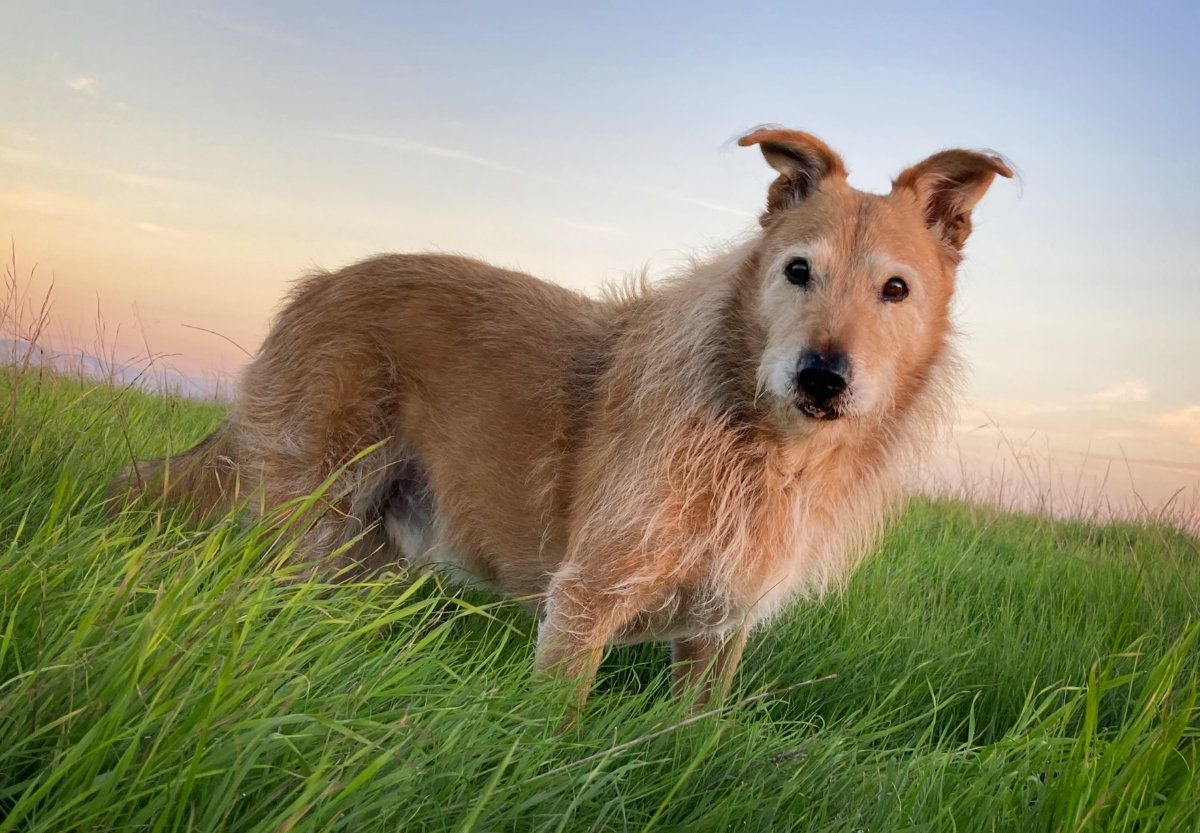
My just-turned 14-year-old dog Otto has lost most of his hearing. Our communication is very limited now. He can no longer hear me tell him what a good dog he is or how much I love him. True, I can shout these things at him, and speak them right into his adorably fuzzy ears, but a loving tone just isn’t the same when you have to raise your voice, or someone is speaking to you with their lips on your head! But thank goodness we have hand signals so I can help him understand what I want him to do.
He can still hear the loudest of handclaps, and this is what I still use to get his attention when I need him to look at me – we won’t discuss how much these claps tend to make my husband jump out of his skin and swear under his breath. When I clap loudly enough, Otto will look at me for information. Then I can signal, “Stay!” with a crossing guard’s “stop” gesture; this now means everything from, “Don’t try to follow me outside, you’re not coming with me to the store,” to “Wait there for a second, I have to run back inside to get my coat.” (I’ve started using the “stay” signal followed by holding up my index finger in a “We’re number one!” gesture to mean something more like our old verbal “wait” cue.)
He’s always been rock-solid on the hand signals for “sit” and “down” and “stand” – but I honestly don’t ask him to do these behaviors much anymore. His arthritis makes it increasingly difficult to stand up from a down and to lower himself into a sit. Now he gets treats just for showing up and standing with us attentively when I ask my younger dog to sit, down, and stand. He likes that a lot!
I never really taught him a hand signal for “Come.” My cue has always been a verbal “Here!” or a whistle. That was a bad oversight, because “come to me” is something I ask him to do many times a day, especially now that it’s cold and I no longer leave doors open for him to come into my office or into the house whenever he gets around to it. Sometimes he stands outside 50 yards away, trying to decide if he’s going to hang out outside (he’s got the run of our fenced two acres) or follow me into my warm office. I stand in my office doorway grumbling. “All the heat is escaping! What are you going to do?” So I’ve started teaching him a physical recall cue. Spontaneously, it turned into something a bit theatrical. I reach my arms out toward him, and then pull them back to my chest, like an endangered woman in a silent film, imploring the hero to come back and save her. It looks a little silly, but he can see it from a good distance away, and he’s picked it up quickly.
I’ve long used a “thumbs up” gesture as an alternative to a click or “Yes!” to mark the moment he does a behavior I’ve cued or, to be honest, anything else that I like. I’m so grateful that I taught him that alternative to ”Yes!” because, basically, in my eyes, he can’t do anything “wrong” anymore. He’s always a good boy, and I give him the “thumbs up” and a big smile many times a day. Again, thank goodness he knows that one, because it’s one of the few things I can do now to make his “concentrating” expression soften and his tail wag.
Don’t wait until it’s too late to teach your dog hand signals – if for no other reason than as a hedge for his or her old age. You can thank me later.
Here are just a few of the many articles we’ve done on teaching hand signals for your cues:
How to Train Hearing Impaired Dogs Using Hand Signals and Simple Gestures
Dog Training With Hand Signals
Special Needs Training: Training Dogs with Hand Signals


My standard poodle is 10 months. He knows a lot of commands. However, I would like to speak less; so I use hand commands and gestures. I find this works best for both us. I feel less stressed as well. The constant sit, stand, no, wait, leave, up, down etc. was a bit much.
I’ve always used hand signals for puppies, along with verbal under the idea that hand signals would be easier to learn than verbal language. I now have a 12 year old lab rescue who doesn’t seem to hear a sound but does seem to respond to my hand and body signals. The young woman who gave him up to me was disconcerted by his always watching her, not realizing that he was probably watching for signals.
When we had Little Old Sammie (who lived long enough to be technically both blind and deaf) we used touch to communicate.
Bless his little heart 🙁
My heart goes out to you Karen. So hard to lose our beloved friends.
I also used hand signals for my guy thinking that very thing for when he got older and he would lose his hearing and then he started getting cataracts in his eye and I thought oh goodness the hand signals aren’t going to help him if he can’t see. We would use a hand signal to come bending it towards us if he was facing the other way and he was close by we would tap him on his body and he would turn and then we would use the hand signal. He always responded very well I used one early on when he was about 5 and I would pat the top of my head and that with me asking him if he wanted a special treat, without using words. He knew it because he would always start barking when I did that. I miss him so much. He passed away last year being over 18 and I had him for over 17 years. Bear was a very good boy.
My girl reached the ripe age of 15. I started hand signals when she was a puppy because I knew of course she would age and lose her hearing eventually. Most important was recall to bring her inside. I brought my fingers towards me with my palm up.
Westie
Lovely article Nancy dear! My Weston of very blessed memory and who lost her hearing late in her almost 20 years was so attentive to hand signals….but was at times a most stubborn ‘scot’! She could at times be selective as to action taken! I love reading about you and your loved ones! Good health and happiness to all of them! Seasons greetings Lorraine Glogauer
I think it is wonderful how you are giving folks some tips on dealing with deaf dogs. I have two out of seven at the moment. The eleven year old Standard Poodle does pretty well with hand gestures. The fifteen and a half year old Havanese not so well as she also has dementia. Every day with her is a gift now and fortunately we retired several years ago so I can pay close attention to her most of the time.